Hemp Leaves Seamless Patterns: A Versatile Resource for Creative and Professional Design Work
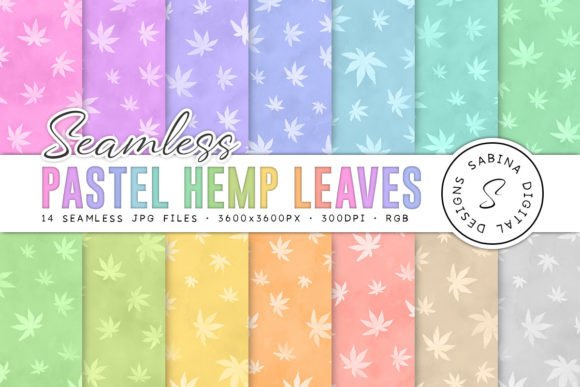
Seamless patterns—repeating graphic elements that tile infinitely without visible seams—are foundational tools across visual design disciplines. Among the most distinctive and increasingly sought-after motifs are Hemp Leaves Seamless Patterns. These botanical-inspired designs combine organic authenticity with subtle sophistication, offering creators a natural yet modern aesthetic that resonates across industries—from sustainable branding to mindful craft projects. What sets this particular collection apart is not just its thematic focus, but its thoughtful technical execution: a curated set of 14 seamless pastel backgrounds featuring an ultra-light watercolor texture, delivered as high-resolution JPG files optimized for both digital flexibility and print fidelity.
Why Hemp Leaves? Beyond Trendiness to Timeless Relevance
Hemp leaves carry layered cultural, ecological, and visual significance. Unlike generic botanical motifs, they evoke clarity, resilience, and groundedness—qualities increasingly valued in design language today. Their five-lobed silhouette is instantly recognizable yet highly adaptable: scalable without losing character, stylizable without sacrificing identity, and harmonious when paired with soft color palettes. This makes Hemp Leaves Seamless Patterns especially effective for audiences seeking authenticity without austerity. They avoid the stark minimalism of some botanical graphics or the over-saturation of tropical motifs—instead landing in a balanced, approachable middle ground.
In practice, this translates to strong performance in contexts where tone matters as much as aesthetics. A wellness startup might use a mint-and-lavender hemp leaf pattern for email headers to reinforce calm, plant-based values. An educator designing printable mindfulness worksheets may select a barely-there sage-green version to add quiet visual rhythm without distracting from content. Even researchers presenting sustainability data can integrate these patterns into slide backgrounds—subtly reinforcing thematic alignment without overt symbolism.
Technical Excellence Meets Creative Utility
The technical specifications of this collection are deliberately aligned with real-world production needs:
- Precision resolution: Each file is 3600×3600 pixels at 300 DPI—ensuring crisp output on 12″×12″ physical prints, such as scrapbook pages, greeting cards, or fabric swatches.
- RGB color mode: Optimized for screen-based workflows (web banners, social media assets, presentations) while maintaining sufficient color depth for professional CMYK conversion if needed.
- True seamlessness: No visible repeats or alignment artifacts—even when scaled or tiled across large-format surfaces like trade show backdrops or packaging mockups.
- Pastel palette + watercolor texture: The gentle wash effect adds tactile warmth and dimension, preventing flatness often associated with vector-based seamless patterns. It’s perceptible enough to enrich, but light enough to preserve legibility of overlaid text or illustrations.
This combination bridges a common gap: many seamless pattern libraries prioritize either bold graphic impact or delicate hand-drawn charm—but rarely both. Here, the watercolor subtlety ensures versatility across applications where visual noise must be minimized, while the underlying hemp leaf structure provides consistent thematic cohesion.
For Crafters and Hobbyists
Scrapbooking, card making, and journaling thrive on textures that feel personal and intentional. These Hemp Leaves Seamless Patterns serve as ideal base layers—soft enough to let photos and handwritten notes remain focal, yet distinctive enough to unify multi-element layouts. Because each pattern is delivered as a standalone JPG, users can drag-and-drop directly into platforms like Canva, Cricut Design Space, or Adobe Express without wrestling with clipping masks or transparency issues. A lavender-hued hemp leaf background, for instance, pairs naturally with dried flower photography or neutral-toned ephemera, supporting storytelling rooted in seasonality and simplicity.
For Marketing and Brand Teams
Marketing materials—especially those tied to wellness, sustainability, education, or artisanal goods—benefit from patterns that communicate values without verbosity. Rather than relying solely on stock photography or generic icons, teams can embed meaning through repetition: using a single Hemp Leaves Seamless Pattern across email templates, social banners, and downloadable guides to build cohesive brand recognition. The pastel range avoids gendered or age-specific connotations, making it suitable for B2B health tech firms as easily as for local herbal apothecaries. Importantly, because all 14 variations share the same underlying motif and texture language, switching between them maintains continuity—unlike mixing unrelated patterns, which risks visual fragmentation.
For Educators and Content Creators
Teachers designing printable resources—lesson plans, behavior charts, vocabulary cards—often face a dilemma: overly busy backgrounds hinder readability; completely blank ones feel sterile. These patterns resolve that tension. A pale sky-blue hemp leaf tile, for example, provides just enough visual interest to support focus during independent work time, while remaining low-contrast enough to prevent eye strain during extended screen use. Similarly, podcasters or course creators building Notion dashboards or LMS modules can apply these as subtle section dividers or sidebar accents—enhancing navigation without competing with core content.
For Small Business Owners and Print-on-Demand Sellers
Entrepreneurs launching eco-conscious product lines—think reusable bags, ceramic mugs, or organic cotton apparel—need scalable, licensable assets that reflect their mission. With 14 distinct variations, this collection offers immediate variety for A/B testing product mockups or developing seasonal collections (e.g., pairing a warm peach-toned hemp leaf with spring-themed copy, then shifting to a cool seafoam version for summer). Because files are print-ready at 12″×12″, they integrate smoothly into platforms like Printful or Gelato without upscaling compromises. And unlike subscription-based pattern libraries, owning these JPGs means no recurring fees or attribution requirements—critical for commercial scalability.
Design Integration Tips: Getting the Most From the Collection
Maximizing utility goes beyond downloading and applying. Consider these practical refinements:
- Color adaptation: While the pastel base is intentionally versatile, most design software allows non-destructive hue/saturation adjustments. Lightening a pattern further enhances its use as a near-transparent overlay; deepening contrast slightly strengthens presence for packaging or signage.
- Layering strategy: Combine one Hemp Leaves Seamless Pattern with a second subtle texture—like fine linen or faint paper grain—at 5–10% opacity. This creates depth without clutter, ideal for premium stationery or presentation decks.
- Cropping for specificity: Though seamless, each 3600×3600 canvas contains ample negative space. Selecting a 1000×1000px excerpt can yield a unique “hero” tile for website headers or app icons—retaining motif integrity while adding custom framing.
- Accessibility awareness: When placing text over any pattern, maintain a minimum 4.5:1 contrast ratio. Pastels generally perform well with charcoal or deep olive text—but always verify using browser developer tools or contrast checkers.
Contextual Considerations: When and When Not to Use
Like any design asset, effectiveness depends on alignment with intent and audience. Hemp Leaves Seamless Patterns excel in environments valuing calm, intentionality, and natural systems—but may underperform in contexts demanding urgency, high-energy dynamism, or maximalist expression. For example, they’re less suited to gaming interfaces, financial trading dashboards, or youth-oriented candy branding, where bolder contrasts or faster visual rhythms dominate.
Equally important is cultural context. While hemp carries positive associations in many regions—particularly around sustainability and wellness—designers working globally should remain aware of regional regulatory or semantic nuances. In some markets, visual references to cannabis-related plants may require additional contextual framing (e.g., pairing with clear sustainability messaging) to preempt misinterpretation.
Looking Ahead: Pattern Design in an Age of Intentional Aesthetics
The rise of Hemp Leaves Seamless Patterns reflects broader shifts in visual culture: away from disposable trends and toward considered, values-aligned design. Consumers and professionals alike increasingly reject homogenized aesthetics in favor of motifs that signal care—in sourcing, in execution, in message. Watercolor textures suggest human touch; botanical forms imply connection to systems larger than the self; pastel palettes convey restraint and clarity.
What makes this collection particularly future-resilient is its balance of specificity and adaptability. It isn’t merely “a leaf pattern”—it’s a hemp leaf pattern, carrying embedded meaning. Yet its execution avoids literalism or heaviness, allowing it to evolve with usage rather than date itself. As design continues prioritizing empathy, sustainability, and cognitive ease, resources like these won’t just remain relevant—they’ll become reference points for how thematic coherence and technical precision can coexist without compromise.