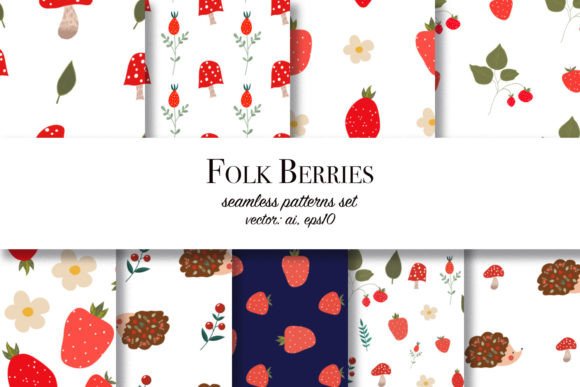
Folk Berries Set of Seamless Patterns: A Versatile Design Resource for Creative Professionals and Entrepreneurs
Seamless patterns remain one of the most enduring and adaptable assets in visual design—bridging tradition and modern production with quiet efficiency. The Folk Berries Set of Seamless Patterns exemplifies this balance: a curated collection rooted in organic, hand-inspired illustration yet engineered for precision digital application. Comprising nine distinct motifs, each pattern merges folk-art warmth with technical readiness—making it equally valuable to a textile designer developing seasonal collections, a small-batch stationery maker printing invitation cards, or an interior brand specifying wallpaper for boutique hospitality spaces.
Technical Readiness Meets Artistic Integrity
What distinguishes this set from generic pattern libraries is its dual commitment—to aesthetic authenticity and production-grade utility. Every pattern is delivered in three essential formats: AI (Adobe Illustrator), EPS10, and high-resolution JPG. This tri-format approach ensures compatibility across workflows: vector files (AI and EPS10) preserve infinite scalability and editability for logo integration, fabric repeats, or packaging die-lines; the JPG variant serves immediate layout use, mockup generation, or CMS uploads where vector support is limited.
Each file renders at 5000×5000 pixels, a dimension that comfortably supports large-format output—from 3-meter-wide wall murals to detailed embroidery digitizing—without interpolation artifacts. With RGB color mode and 300 DPI resolution, the set aligns with standard prepress expectations for both screen-based presentation and high-fidelity print reproduction. Unlike many “seamless” downloads that rely on tile-based repetition without true edge continuity, these patterns undergo manual alignment verification—ensuring no visible seams appear even when tiled across expansive surfaces like retail backdrops or apparel yardage.
Real-World Applications Across Industries
The versatility of the Folk Berries Set of Seamless Patterns emerges not from theoretical flexibility but from documented, repeatable implementation across diverse sectors. Below are representative use cases grounded in current creative practice:
- Invitation cards and stationery: The subtle texture and rhythmic berry motifs lend themselves naturally to wedding suites, baby announcements, or artisanal business cards—adding tactile sophistication without overwhelming typography.
- Home linens and soft furnishings: When scaled appropriately, the patterns translate gracefully to duvet covers, napkin sets, and cushion fabrics—offering warmth and narrative depth that mass-produced prints often lack.
- Printed scarves and fashion textiles: With their balanced motif density and organic flow, several patterns function effectively as scarf borders or full-field prints on silk or viscose—supporting both drape and detail retention during cutting and sewing.
- Wallpapers and interior surfaces: Interior designers increasingly favor custom or semi-custom wall coverings for residential and commercial projects. These patterns scale cleanly to standard roll dimensions (e.g., 53 cm × 10 m), and their folk-inflected charm suits Scandinavian, Japandi, and cottage-core aesthetics alike.
- Packaging and paper goods: From kraft gift boxes to branded paper bags, the patterns provide consistent visual identity across touchpoints—especially effective when paired with minimalist typography or foil stamping.
- Jewelry and accessory branding: Smaller-scale iterations work well for pouch linings, display tray inserts, or even engraved metal tags—where pattern subtlety reinforces brand ethos without competing with product form.
Why Seamless Matters—Beyond Convenience
“Seamless” is often treated as a checkbox feature—but its functional implications run deeper than workflow speed. In textile manufacturing, a truly seamless repeat eliminates costly misalignment during roller printing, reducing waste and ensuring consistency across thousands of meters of fabric. In digital environments, seamless tiling enables responsive background behavior: a single pattern file can fluidly adapt to variable screen widths, app UI containers, or social media story dimensions without distortion or cropping artifacts.
Moreover, seamlessness supports sustainability in design iteration. Because each pattern tile functions independently, creators can test variations—color swaps, opacity adjustments, or layering with halftones—without rebuilding the entire repeat structure. This modularity reduces time spent on revision cycles and encourages experimentation with tone, contrast, and cultural resonance—particularly relevant when adapting folk motifs for global audiences.
User-Centered Workflow Integration
Designers and business owners rarely adopt assets in isolation—they integrate them into existing systems, tools, and team structures. The Folk Berries Set of Seamless Patterns accommodates this reality through intentional file architecture:
- Color consistency: All files use RGB mode, enabling accurate soft-proofing across calibrated monitors—a critical consideration for remote collaboration between illustrators, printers, and clients.
- Version control clarity: EPS10 compatibility ensures backward compatibility with older Adobe Creative Suite installations, while AI files support modern features like global colors and linked assets—reducing friction during handoffs.
- Scalability confidence: At 5000×5000 px, the JPGs exceed common digital signage requirements (e.g., 4K UHD at 3840×2160), meaning users can repurpose the same asset for Instagram carousels, trade show banners, and email headers without re-exporting.
This level of technical foresight means less time troubleshooting rasterization errors or color shifts—and more time refining brand voice, testing market response, or iterating on physical prototypes.
Thoughtful Adaptation for Diverse Audiences
The patterns’ folk-art foundation offers interpretive openness: they avoid rigid cultural signifiers while retaining enough botanical specificity (blackberries, hawthorn, rose hips) to feel grounded and legible. Educators use similar motifs in design history units to discuss regional ornamentation traditions; researchers studying visual literacy cite berry-based patterning as an accessible entry point for analyzing motif hierarchy and rhythm perception; hobbyists appreciate the intuitive repeat logic—ideal for learning pattern construction in beginner-friendly software like Affinity Designer or Canva’s vector modules.
For entrepreneurs launching lifestyle brands, the set provides a rare combination: professional-grade files without requiring advanced vector expertise. A café owner sourcing custom napkins can supply the JPG directly to their printer; a ceramicist designing limited-edition box packaging can import the AI file into Silhouette Studio for precise cut-line registration. No licensing ambiguity, no subscription dependency—just immediate, owned utility.
Practical Considerations for Long-Term Use
While the Folk Berries Set of Seamless Patterns excels in breadth and fidelity, thoughtful implementation still requires attention to context. For example:
- Scale calibration: A motif that reads beautifully at 12-inch repeat width may vanish entirely on a 2-inch fabric swatch. Always test at intended output size—not just on-screen zoom.
- Color translation: RGB-to-CMYK conversion can mute berry reds or desaturate leaf greens. When preparing for offset printing, generate a press proof using the printer’s ICC profile rather than relying on default conversions.
- Cultural sensitivity: Though stylized, the berry forms reference real botanical species. When adapting for international markets, verify naming conventions and symbolic associations—e.g., hawthorn carries different connotations in Irish folklore versus East Asian herbal traditions.
- File hygiene: Keep AI/EPS master files separate from working copies. Rename JPG exports clearly (e.g., “FolkBerries_Sage_5000px.jpg”) to prevent version confusion during collaborative reviews.
These aren’t limitations of the set—they’re universal considerations in applied design. What makes this collection especially supportive is how its technical specifications anticipate and mitigate many of these variables before they become bottlenecks.
Connecting Craft to Contemporary Practice
In an era where algorithmic pattern generators flood marketplaces with homogenous outputs, hand-informed resources like the Folk Berries Set of Seamless Patterns offer something quieter but increasingly vital: human intentionality encoded in scalable form. Each berry cluster reflects decisions about weight, spacing, and negative space—not just decorative impulse, but compositional reasoning honed through observation of natural growth patterns and traditional textile archives.
That intentionality transfers directly to end products. A scarf printed with these motifs doesn’t merely “look handmade”—it behaves like one, guiding the eye with gentle rhythm rather than demanding attention through contrast or novelty. That quality resonates across demographics: millennials seeking authenticity in home goods, Gen Z consumers valuing slow-design ethics, and legacy brands refreshing heritage lines without abandoning core visual language.
If you encounter unexpected behavior during implementation—whether inconsistent tiling in your layout software, unexpected color shifts in export, or questions about optimal scaling for a specific substrate—the creator welcomes direct contact. This isn’t just customer service—it’s continuity of craft knowledge, extending beyond the download into real-world problem-solving. You’ll also find ongoing inspiration and community insight on Instagram gingerbirb, where pattern studies, scale experiments, and cross-industry adaptations are shared transparently.