Candy Digital Paper, Seamless Patterns
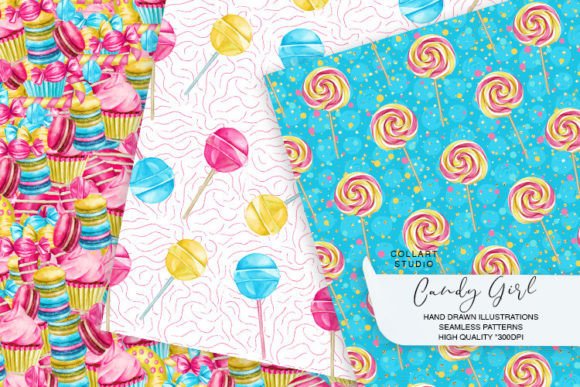
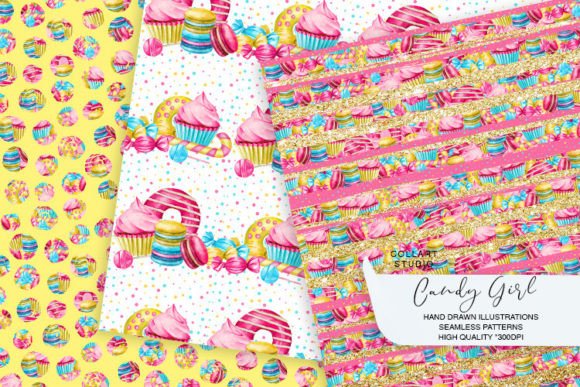
Imagine opening a design file and instantly having a rich, tactile texture at your fingertips—hand-painted, expressive, and infinitely scalable. That’s the quiet power of Candy Digital Paper, Seamless Patterns: three original, high-resolution digital papers created by the Collart Studio team using authentic hand-drawn techniques. Each pattern is built to tile flawlessly—no visible seams, no awkward repeats—so whether you’re filling a 12×12-inch planner sticker sheet or scaling up for a fabric print, the continuity stays natural and intentional.
Why seamless digital paper matters now
Today’s creative workflows demand flexibility without compromise. Designers, educators, small business owners, and DIY enthusiasts are increasingly working across multiple platforms—Canva for social graphics, Procreate for custom illustrations, Adobe Illustrator for vector-ready assets, or even Cricut Design Space for physical cutting projects. In that context, a rigid, fixed-size image isn’t just inconvenient—it’s limiting. Seamless patterns solve that. They let users build custom-sized backgrounds, repeat motifs across large-format prints, or adapt a single design to dozens of use cases without reworking alignment or editing out edges.
This shift reflects broader habits: more people are designing *for themselves*, not just for clients or publishers. A teacher might need printable lesson-planner borders one day and classroom bulletin board backdrops the next. A wedding planner may source the same pattern for digital invites, printed napkin wraps, and vinyl decals—all from one file. The expectation isn’t just “good enough”—it’s cohesive, professional, and effortless to deploy.
Hand-painted authenticity in a digital world
What sets Candy Digital Paper, Seamless Patterns apart isn’t just technical precision—it’s human texture. These aren’t algorithm-generated repeats or stock-vector abstractions. Each of the three designs was hand painted and drawn by the Collart Studio team, then carefully digitized and tested for true seamlessness. That means subtle variations in brushstroke, pigment bleed, and organic line weight remain intact—even when tiled hundreds of times.
In an era where AI-generated visuals flood feeds and marketplaces, this kind of intentionality stands out. Consumers—and creators—respond to warmth, irregularity, and evidence of craft. A hand-painted floral motif feels different from a symmetrical geometric repeat, even if both are technically seamless. It signals care, personality, and a point of view—not just utility.
Practical applications across real-world roles
The versatility of these papers isn’t theoretical. It shows up daily in how people actually work:
- Planner stickers and printable inserts: Use one pattern as a full-page background for weekly spreads, another as a border for habit trackers, and the third as a textured overlay behind handwritten notes—all while preserving crisp 300 dpi clarity at 12×12 inches.
- Web and blog design: Apply a subtle candy-inspired pattern as a CSS background image (using
background-repeat: repeat) for headers or section dividers. Its seamless nature ensures consistent rendering across devices, no cropping or distortion required. - Scrapbooking and invitations: Layer patterns behind photos or text blocks in digital scrapbook kits—or export them as PDFs for professional printing. Because they’re 300 dpi and sized to industry-standard 12×12 inches, they integrate cleanly with most print-on-demand services.
- Fabric and paper crafts: For decoupage, papercutting, or textile prototyping, the ability to tile means you can generate yardage-length repeats without losing resolution or visual integrity. No need to stitch panels together manually or risk misalignment.
Freelancers building brand kits appreciate this too. A single Candy Digital Paper, Seamless Pattern can become part of a client’s visual language—used consistently across social banners, email footers, and presentation decks—without requiring custom illustration for each format.
How resolution and format support modern production needs
The choice of 300 dpi at 12×12 inches isn’t arbitrary. It meets two key thresholds: first, it satisfies commercial print standards for sharpness and detail; second, it provides enough pixel density to allow meaningful resizing downward (e.g., for web thumbnails or mobile UI elements) without noticeable degradation. Unlike low-res JPEGs or compressed PNGs that blur when enlarged, these files retain fidelity because they were built at production-grade resolution from the start.
And because they’re delivered as instant-download digital files—not physical swatches or subscription-based libraries—they fit into lean, on-demand workflows. No shipping delays. No inventory management. No licensing ambiguity. Just three clean, ready-to-use assets—each unique, each tested, each designed to behave predictably in software ranging from beginner-friendly tools like PicMonkey to professional suites like Affinity Designer.
Evolving expectations for digital design assets
A decade ago, many digital paper collections prioritized quantity over cohesion—hundreds of patterns, often sourced from generic clip art or outsourced vectors. Today, users gravitate toward smaller, curated sets where every piece has purpose and personality. That mirrors shifts in broader creative culture: the rise of micro-brands, the emphasis on signature aesthetics in Instagram feeds and Etsy shops, and the growing preference for assets that feel *owned*, not borrowed.
Candy Digital Paper, Seamless Patterns responds to that shift. Three designs may sound minimal—but each is built to carry weight. They’re not filler. They’re foundations. And because they’re seamless, they scale with your ambition: a single pattern can anchor a product line, define a seasonal campaign, or become the unifying thread across a year’s worth of planner pages.
Realistic integration tips for different users
You don’t need advanced skills to benefit from these papers. Here’s how different users can start simply:
- Hobbyists and educators: Import a pattern into PowerPoint or Google Slides as a slide background. Duplicate the slide, then crop or mask sections to create themed templates—“Reading Log,” “Science Lab Notes,” or “Goal Tracker.”
- Bloggers and content creators: Use one pattern as a consistent header image across all blog posts. Save time by creating a Photoshop action or Canva template that auto-applies it with your logo and title font.
- Small business owners: Combine a Candy Digital Paper with your brand colors in a free tool like Photopea to mock up packaging labels or thank-you card designs—then send those files directly to your printer.
- DIY crafters: Load the file into Cricut Design Space, resize it to fit your mat, and use it as a background layer beneath cut-out shapes—perfect for layered greeting cards or framed wall art.
No special plugins. No steep learning curve. Just intuitive, immediate utility—backed by thoughtful craftsmanship.
Looking ahead—without overpromising
Digital papers won’t replace illustration or photography. But they’re becoming essential connective tissue in visual communication—bridging handmade charm with digital efficiency. As tools grow more accessible and audiences grow more visually literate, the value of well-made, versatile, human-centered assets only increases.
Candy Digital Paper, Seamless Patterns doesn’t try to do everything. It does three things exceptionally well: it delivers hand-painted character, technical reliability, and cross-platform readiness. For anyone who designs, teaches, organizes, sells, or makes—those qualities aren’t nice-to-haves. They’re daily necessities.