Boho Patterns, Bohemian Patterns: A Practical Guide for Designers and DIY Creators
Boho Patterns, Bohemian Patterns refer to a family of decorative motifs rooted in the bohemian aesthetic—characterized by organic shapes, earthy tones, layered textures, and hand-crafted irregularity. These patterns often incorporate botanical elements (like wildflowers, leaves, and vines), abstract swirls, ethnic-inspired symbols, and freeform line work. Unlike rigid geometric repeats, authentic boho patterns emphasize spontaneity and tactile warmth—qualities that are especially valued in handmade and artisanal design contexts.
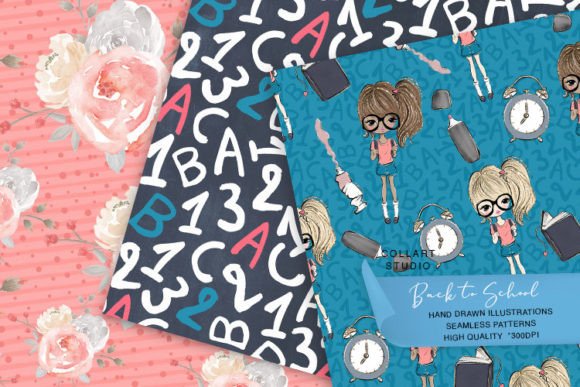
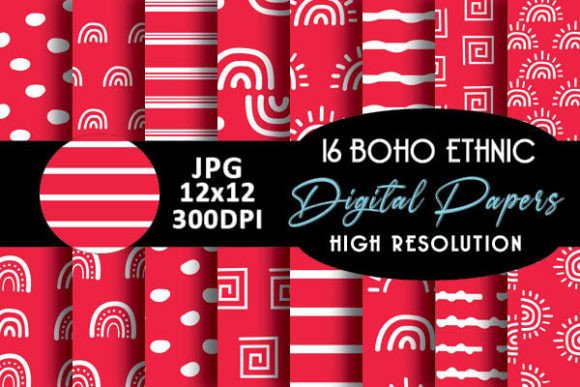
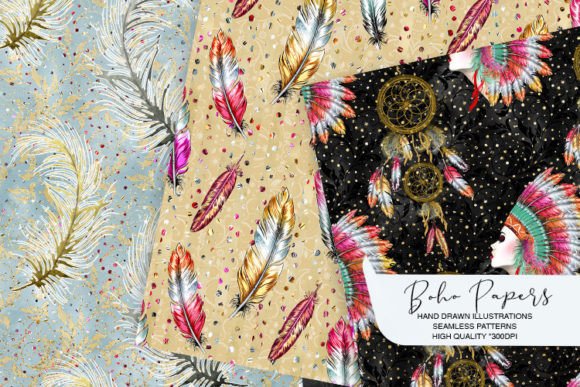
When sourced as digital papers—as in the case of the three seamless designs created by Collart Studio—they become versatile, scalable assets for both digital and physical projects. Each paper is hand-painted and hand-drawn, then digitized at 300 dpi resolution and sized to 12×12 inches. The seamless tiling property means users can repeat the pattern horizontally and vertically without visible seams—ideal for extending coverage across large surfaces or custom dimensions.
Why Designers and Makers Seek Boho Patterns
Interest in Boho Patterns, Bohemian Patterns typically arises from specific creative or functional needs—not just stylistic preference. For example:
- Planner sticker designers use them as backgrounds for printable stickers, ensuring visual cohesion while maintaining readability.
- Blog and web designers integrate them into headers, dividers, or section accents to add texture without sacrificing load speed—especially when optimized for web use.
- Scrapbookers and invitation designers rely on high-resolution, print-ready files to avoid pixelation when scaling or layering with photos and typography.
- Fabric and paper crafters apply them to decoupage, wrapping paper, or textile printing—provided the file format and color profile support accurate reproduction.
The appeal lies less in trendiness and more in practical adaptability: these patterns offer an accessible way to introduce artisanal character without requiring illustration skills or time-intensive manual creation.
Key Benefits and Realistic Expectations
Three core benefits stand out for users evaluating Boho Patterns, Bohemian Patterns like those from Collart Studio:
- Seamless scalability: Because each design tiles cleanly, users can generate large-format prints (e.g., 24×36 inch posters) or repeated fabric yardage without gaps or misalignment—reducing trial-and-error in layout software.
- High-fidelity output: At 300 dpi and 12×12 inches, the files retain clarity when printed at common craft sizes (e.g., 2×2 inch stickers or 5×7 inch invitations). This matters most for physical outputs where resolution directly affects perceived quality.
- Authentic texture: Hand-painted origins translate to subtle variations in line weight, pigment bleed, and grain—qualities difficult to replicate convincingly with algorithm-generated patterns.
However, expectations must align with the medium. These are digital papers—not editable vector files. Users cannot isolate individual elements (e.g., extract just the flower motif) or recolor components non-destructively without raster editing expertise. Also, while the earthy palette suits many boho applications, it may require adjustment via software (e.g., hue/saturation layers) for projects needing brighter or monochrome schemes.
Situations Where Boho Patterns Are a Strong Fit
These digital papers serve best when the project prioritizes:
- Consistent, repeatable texture—such as covering planner tabs, journal covers, or gift wrap with uniform visual rhythm.
- Print-first workflows—where high-resolution raster files simplify preparation for home printers, local print shops, or print-on-demand services.
- Time-constrained ideation—when a designer needs trustworthy, cohesive background elements without commissioning custom art or sifting through low-quality free resources.
- Tactile authenticity—for audiences that respond to visible brushwork, ink variation, or watercolor bleed (e.g., wedding stationery targeting a “handmade” feel).
In such cases, Boho Patterns, Bohemian Patterns reduce iteration time while preserving aesthetic integrity—making them efficient tools rather than mere decorations.
When Alternatives May Be More Suitable
Not every project benefits equally from this type of resource. Consider alternatives if:
- You need full-color customization (e.g., matching exact brand Pantones across all pattern elements). Raster-based boho patterns require manual color correction, whereas vector swatches or SVG-based pattern generators allow precise, global adjustments.
- Your work involves frequent resizing across extreme scales—such as adapting a motif for embroidery floss charts (small) and wall murals (large). Vector patterns scale losslessly; raster files risk softness or aliasing outside their native resolution.
- You require commercial licensing for resale items with embedded patterns (e.g., selling digital sticker sheets containing the design). Always verify license terms—some boho pattern bundles restrict derivative commercial use unless explicitly stated.
- Your workflow depends on program-specific features, like Adobe Capture’s pattern-recognition tools or Procreate’s brush-based pattern stamping. Pre-made seamless papers won’t integrate natively with those functions.
Making an Informed Choice
Evaluating Boho Patterns, Bohemian Patterns comes down to matching file properties to project requirements—not just visual alignment. Ask yourself:
- Will the final output be primarily digital (web, PDF) or physical (print, fabric)? High-res raster files excel in the latter but demand careful export settings for the former.
- Do I need to modify individual components—or is the pattern used as a unified background? If modification is essential, vector alternatives or layered PSD files may offer greater flexibility.
- How much time do I have for asset preparation? Seamless, print-optimized files reduce prepress steps, but lack built-in color variants or alternate layouts.
- Does the hand-painted texture enhance or distract from my message? In minimalist or data-heavy designs, intricate boho motifs may compete for attention rather than support hierarchy.
For creators balancing authenticity with efficiency—and whose goals include planner accessories, event design, or small-batch crafts—Boho Patterns, Bohemian Patterns like those from Collart Studio provide a grounded, production-ready option. They reflect a deliberate choice for human-made nuance over synthetic uniformity, and their seamless, high-resolution format supports real-world implementation without hidden technical debt.
Ultimately, the value isn’t in the pattern alone, but in how reliably it serves your next tangible outcome—whether that’s a stack of printed invitations, a cohesive set of digital stickers, or the first prototype of a fabric line.