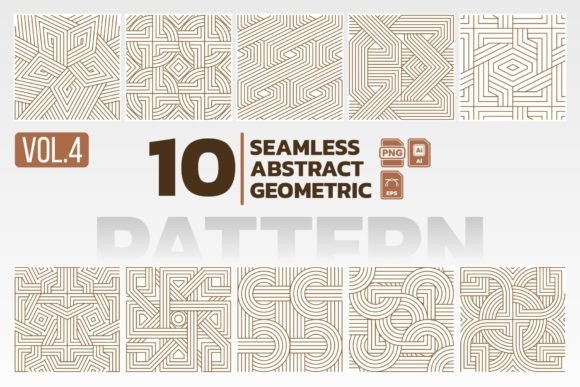
10 Seamless Geometric Line Patterns Vol4: A Practical Evaluation for Designers and Creators
10 Seamless Geometric Line Patterns Vol4 is a curated vector pattern collection focused exclusively on clean, precise line-based geometry. Unlike broader pattern bundles that mix motifs—florals, organic shapes, or textured repeats—this set maintains strict formal discipline: every pattern relies on consistent stroke weight, deliberate spacing, and mathematical alignment to achieve visual rhythm without visual noise. It’s designed for professionals who need predictability in repetition, not decorative variety.
What You Actually Get—and Why Format Matters
The package delivers three complementary file types, each serving distinct workflow needs:
- 10 EPS v10 files: Fully editable, resolution-independent vector patterns compatible with older and newer design software. Ideal for users maintaining legacy Illustrator versions or requiring maximum compatibility across print production pipelines.
- 10 AI v10 files: Native Illustrator documents with patterns saved as swatches—ready to apply instantly to shapes, text outlines, or artboards. These support live editing of color, scale, and rotation without breaking seamlessness.
- 10 PNG files (3000×3000 px, black lines on transparent background): High-resolution raster previews useful for quick mockups, web prototyping, or when vector editing isn’t feasible. The transparency enables layering over photos, gradients, or complex backgrounds without clipping masks.
This tri-format approach avoids forcing users into a single editing paradigm. If you’re building a textile repeat in Adobe Illustrator but also need to test how a pattern reads on a mobile UI in Figma, the PNGs bridge that gap without requiring conversion tools or risking fidelity loss.
How It Stands Apart From Broader Pattern Libraries
Many pattern collections prioritize density, complexity, or stylistic range—think hand-drawn sketches, watercolor overlays, or layered multipattern compositions. 10 Seamless Geometric Line Patterns Vol4 takes the opposite stance: it’s minimal by design, not by omission. Each pattern uses only one line weight and a single hue (black in the PNGs), making it easier to recolor, scale, or integrate into systems where consistency matters more than contrast.
Compare this with pattern sets built around “trend-driven” aesthetics—grunge textures, maximalist grids, or retro-inspired halftones. Those serve specific moods or campaigns. This set serves structure: it’s suited to branding systems needing subtle background texture, architectural visualization overlays, technical documentation borders, or UI elements where legibility must remain uncompromised.
Real-World Fit: Where These Patterns Deliver Value
Consider these practical applications—and where expectations might misalign:
- Greeting cards & stationery: The precision works well for foil-stamped or laser-cut designs where crisp edges matter. But if your project requires soft edges or ink bleed simulation, these sharp vectors won’t emulate that behavior without additional manual adjustment.
- Web page backgrounds: The PNGs load quickly at 3000×3000 px and tile cleanly via CSS
background-repeat. Because they’re black-on-transparent, they adapt seamlessly to light or dark mode interfaces—no need to generate alternate color versions. - Textiles & surface design: The seamless nature means no visible joins at fabric edges—but note: these are line-only patterns, not motif-based repeats like paisleys or geometrics with filled shapes. They suit modern apparel brands emphasizing negative space, not traditional print houses expecting dense, all-over coverage.
- Wrapping paper & packaging: Scale flexibility helps—zoom in for luxury product boxes, zoom out for large-format retail bags. However, because there are no tonal variations or shading, very large physical prints may appear flat under certain lighting unless paired with embossing or spot varnish.
Tradeoffs to Acknowledge Before Choosing
No pattern set excels in every context—and understanding limitations prevents mismatched expectations:
- Color flexibility is user-dependent: While the AI and EPS files allow full recoloring, the PNGs are fixed to black lines on transparency. If you need pre-made variants (e.g., navy, charcoal, warm gray), those must be generated locally. This isn’t a flaw—it’s a constraint of delivering high-fidelity raster assets without bloating file count.
- No photorealistic or tactile simulation: These aren’t scanned textures or noise-based overlays. They won’t mimic linen, concrete, or brushed metal. That’s intentional: they’re geometric, not material-based.
- Not optimized for animation or interactive states: While scalable, these aren’t built as SVG sprites or Lottie-compatible assets. For micro-interactions or hover effects, additional development work would be needed.
When 10 Seamless Geometric Line Patterns Vol4 Is Likely the Right Choice
This set fits best when your priority is control, clarity, and cross-medium adaptability—not novelty or stylistic flair. It’s especially relevant if you:
- Work across both print and digital outputs and need identical pattern behavior in each;
- Prefer starting from a neutral base (black lines + transparency) rather than adapting pre-colored or pre-textured assets;
- Value file longevity—EPS and AI v10 remain widely supported, even as newer formats evolve;
- Need patterns that scale infinitely without pixelation, yet avoid the visual weight of filled shapes or gradients;
- Are integrating into design systems where consistency across components (buttons, cards, headers) depends on repeatable, predictable visual language.
It also suits teams with mixed software access—freelancers using older Illustrator versions, agencies standardizing on cloud-based tools, or educators preparing classroom materials where file compatibility can’t be assumed.
When Another Option Might Be More Appropriate
If your project demands:
- Immediate color variety: Look for bundles offering multiple pre-built colorways per pattern—or consider subscription-based services that provide ongoing updates and palette libraries.
- Material realism: Seek out scanned texture packs, Procreate brushes with grain simulation, or Substance Designer materials for 3D or AR contexts.
- Dynamic or responsive behavior: Explore SVG pattern generators, CSS Houdini paint worklets, or JavaScript-driven tiling libraries for web-first projects requiring real-time scaling or interaction.
- Mixed-media integration: Bundles combining vector patterns with matching photo overlays, shadow layers, or displacement maps may better serve editorial or packaging workflows needing depth cues.
None of these alternatives invalidate 10 Seamless Geometric Line Patterns Vol4—they simply reflect different design goals. Choosing hinges less on “best” and more on alignment with your current constraints: timeline, team expertise, output requirements, and long-term maintainability.
Final Considerations for Informed Selection
Before downloading or purchasing, ask yourself two questions:
- Will I edit these—or use them as-is? If editing is rare, the PNGs may cover 80% of your needs. If you regularly adjust scale, color, or spacing per project, the AI or EPS files justify their inclusion.
- Do I need these patterns to behave identically across five different platforms? If yes, the format redundancy here is a strength—not redundancy, but resilience.
The absence of mockup previews (noted as “for illustration purposes only”) means evaluation relies on technical specs and use-case fit rather than aesthetic impression alone. That’s appropriate for professional buyers prioritizing function over first-glance appeal. And the offer of direct support—if editing proves difficult—adds tangible value for users navigating unfamiliar vector workflows.
In summary, 10 Seamless Geometric Line Patterns Vol4 doesn’t try to be everything. It excels where precision, neutrality, and format reliability matter most. For designers weighing options, its value lies not in breadth, but in disciplined execution—and in giving you exactly what you need to move forward, without excess.