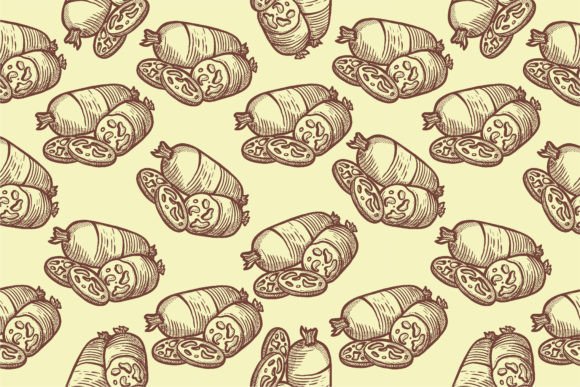
Sausage Vintage Line Art Patterns
Sausage Vintage Line Art Patterns is a curated digital design asset built for creators who value authenticity, consistency, and versatility in visual execution. It’s not just decorative—it’s functional infrastructure. These patterns combine hand-drawn charm with precise vector geometry, making them equally at home on fabric rolls, web interfaces, or printed stationery. Unlike generic clipart or overused stock motifs, this collection carries intentional stylistic cohesion: clean linework, balanced negative space, and subtle imperfections that signal human craftsmanship—not algorithmic repetition.
For professionals managing multiple output formats—whether launching an e-commerce site, designing seasonal packaging, or preparing classroom materials—the ability to deploy one pattern across contexts without visual compromise is a workflow multiplier. Sausage Vintage Line Art Patterns bridges the gap between concept and delivery by offering assets that scale, adapt, and retain integrity whether viewed on a mobile screen or unrolled across six meters of wallpaper.
How It Fits Into Real Creative Workflows
This isn’t a “set and forget” download. Its value emerges most clearly when integrated into stages where visual language must remain stable across touchpoints. Consider a small-batch food brand developing its first product line. Before finalizing labels, the team selects Sausage Vintage Line Art Patterns as the foundational motif—then uses the EPS file to build die-cut templates in Adobe Illustrator, exports the JPG for mockups in Figma or Canva, and applies the AI vector directly into textile swatch software for fabric sampling. That single asset becomes the connective tissue across print, digital, and physical prototyping.
In education, a curriculum designer might embed the pattern as a subtle background in slide decks or printable worksheets—not as decoration, but as a consistent visual anchor that reinforces thematic continuity (e.g., a unit on artisanal food history). Because the 300 dpi JPG is precisely 4.167 × 4.167 px, it tiles seamlessly in PowerPoint or Google Slides without distortion or manual alignment. No cropping, no guesswork—just reliable repetition.
Compatibility and Technical Integration
The inclusion of three file types—EPS, AI, and high-res JPG—isn’t about redundancy. It’s about matching format to function:
- .EPS: Used when precision matters most—especially in large-format printing, embroidery digitizing, or CNC engraving workflows. Its PostScript foundation ensures crisp rendering regardless of output size or RIP software.
- .AI vector file: The editable core. Designers open this in Illustrator to adjust stroke weight, recolor individual elements, or isolate specific sausage motifs for custom arrangements. This is where customization happens—not after purchase, but during active design iteration.
- .JPG (300 dpi, 4.167 × 4.167 px): Optimized for immediate use where vector support isn’t available—think email templates, Shopify theme backgrounds, or PDF-based reports. Its exact square dimension simplifies tiling logic in CSS (
background-repeat: repeat) or desktop publishing tools.
No conversion steps are required. No third-party plugins. No version conflicts. If your tool opens EPS, AI, or JPG—and nearly all professional and mainstream platforms do—you’re ready to implement.
Practical Implementation Tips
Start with purpose, not aesthetics. Ask: Where does visual consistency break down in my current process? Is it between social media banners and printed flyers? Between website headers and physical business cards? That friction point is where Sausage Vintage Line Art Patterns delivers measurable efficiency.
For web use: Apply the JPG as a CSS background image on section divs or body elements. Use background-size: 416.67px (1/10th of the pixel dimension) to control scale without distortion. Pair with neutral typography—serif or geometric sans—to let the line art breathe rather than compete.
For textiles: Import the AI file into pattern-making software like PatternMaker or Adobe Substance Sampler. Adjust spacing to match fabric repeat requirements (e.g., 12" × 12" for quilting cotton), then export as seamless tile PNGs for printer prep. Because the original vector lines are closed paths with uniform stroke alignment, seam blending is predictable—not trial-and-error.
For packaging: Use the EPS in dieline files to ensure cut lines and pattern alignment stay synchronized. When sending files to printers, embed the EPS directly—no need to outline strokes or expand appearances, since the format preserves editability and scalability natively.
Organization and Long-Term Usability
Treat Sausage Vintage Line Art Patterns as a system component—not a one-off purchase. Store all three files in a dedicated “Patterns/Vintage/Sausage” folder within your master design assets library. Name them consistently: sausage-vintage-lineart-eps.eps, sausage-vintage-lineart-ai.ai, sausage-vintage-lineart-jpg.jpg. This avoids confusion when collaborating or revisiting projects months later.
Document usage decisions alongside the files. A simple text note—“Used in Q3 2024 brand refresh: primary color #4A3F35, stroke weight 0.75pt”—saves hours during future audits or rebranding phases. Over time, this builds institutional memory around how the pattern functions in your specific context.
Quality control is built in—but only if you leverage the right file at the right stage. Never upscale the JPG for large-print applications. Never rasterize the AI file unless absolutely necessary for plugin compatibility. And never assume the EPS will render identically in every RIP—test on your target output device first, especially for foil stamping or embossing.
Workflow Synergy With Other Tools and Decisions
Sausage Vintage Line Art Patterns doesn’t exist in isolation. It gains strength through integration:
- Pair with Pantone color libraries when defining brand palettes—the clean linework translates reliably into spot-color separations.
- Use alongside grid-based layout systems (8-pt grid, modular scales) to maintain rhythm between pattern density and content hierarchy.
- Import into Notion or Airtable as a visual tag for design-related tasks—linking the JPG to project briefs or client feedback logs creates traceable context.
- Combine with generative tools like Adobe Firefly only for ideation—not final output. Let the vintage line art anchor the aesthetic; use AI tools to explore complementary textures or layouts around it.
The decision to use Sausage Vintage Line Art Patterns often coincides with broader strategic choices: committing to a cohesive visual identity, standardizing production handoffs, or reducing reliance on external designers for minor asset variations. It supports those decisions by removing friction—not adding complexity.
Efficiency Gains You’ll Notice Within Hours
After your first implementation, watch for these shifts:
- Faster approvals: Clients respond more confidently to designs anchored by consistent, professional-grade patterns—even when other elements are still in draft form.
- Reduced revision cycles: Because the pattern scales predictably, last-minute size changes (e.g., shifting from A4 to A3 posters) don’t trigger new alignment or tiling issues.
- Cross-platform confidence: You stop asking “Will this look right on Instagram *and* in-store signage?”—because the same asset performs reliably in both environments.
- Reusable logic: Once you’ve set up the CSS class or InDesign swatch, you apply it across dozens of pages or documents without reconfiguring.
Sausage Vintage Line Art Patterns works best when treated not as decoration, but as infrastructure—as deliberate, reusable structure that supports clarity, speed, and coherence across everything you make.